


Games are not only won at the table but also through preparation before tournaments. This includes the deckbuilding process. How many copies of each card should you include? What cards should you tech in for the current meta? Let’s explore some basic principles of deckbuilding to get started.
A well-built Pokémon TCG deck balances consistency, tech choices, and synergy. Understanding your main attacker, energy requirements, draw support, and matchups is key to building a competitive Pokémon deck. Whether you’re building for Standard format tournaments or casual local play, focusing on solid fundamentals will give you a strong edge before the first card is even drawn.
Pokemon
First and foremost, to start a game, you must include Basic Pokémon that you can place in the Active spot. If you don’t have any in your opening hand, you’ll be forced to take a mulligan. This gives your opponent the option to draw an extra card for each mulligan you take, an advantage they’ll almost always accept. According to the rules, your deck must include at least one Basic Pokémon. But how many is too many?
While there’s no exact number, a generally safe range is 10 to 15, depending on the type of deck you’re playing. This improves your chances of opening with a Basic Pokémon. However, deckbuilders also need to account for the strength of their Basic Pokémon, especially in decks where the main attackers are Stage 1 or Stage 2, and the Basic forms are weak. If you can’t play a Benched Pokémon by your second turn, you risk losing the game if your Active Pokémon is Knocked Out and you have no backups.
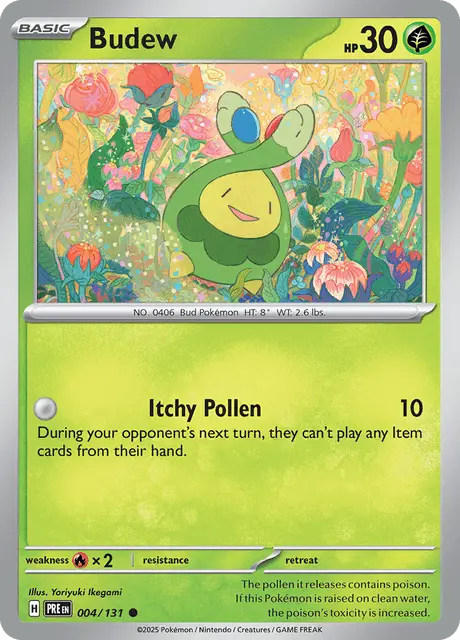
For instance, if your deck includes only a few Basic Pokémon and you start the game with something like a 30 HP Budew, you could easily lose once your opponent finds a way to deal just 30 damage. Even a support Pokémon like Shaymin only needs 2 Energy to do that, knocking out Budew and potentially ending the game right then and there.
Of course, situations like this can be mitigated with the right Trainer cards that help you draw more Pokémon to fill your Bench.

Another key consideration when deciding how many Pokémon to include is in decks that rely on Stage 2 attackers, like Gardevoir ex. How many Kirlia should you run, especially when you have Rare Candy as a Trainer card option? It’s unlikely that players will include as many Stage 1 copies as they do Stage 2 or Basic Pokémon. Typically, these decks run 3 to 4 of the Basic, one fewer Stage 1, and the same number of Stage 2 as Basics.

At the same time, since most Stage 2 attackers are now 2-Prize EX Pokémon, it’s not always necessary to include 4 copies or even 3 of the Stage 2. Some players are content running just 2. This is because decks also need to include support Pokémon like Fezandipiti ex and Mew ex, which are also 2-Prize Pokémon and easy targets for Boss’s Orders or Counter Catcher.
When it comes to supporting Pokémon, while many abilities are useful, it’s important to focus on what’s truly essential. There are several options in the format—Shaymin for Bench protection, Tatsugiri for Supporter search, Fezandipiti ex and Mew ex for draw support—but it’s nearly impossible to fit all of them into one deck.
These cards take up Bench space and can get in the way of setting up your main attackers or core strategy. Be selective and choose what best supports your deck. Realistically, only one or two support Pokémon of this kind will fit comfortably in both the list and the Bench.
Item/Supporter/Stadium/Tool/ACE SPEC
These 4 types of Trainer cards form the support backbone of your deck, helping you speed up your deck to achieve your ideal set-up.
Item

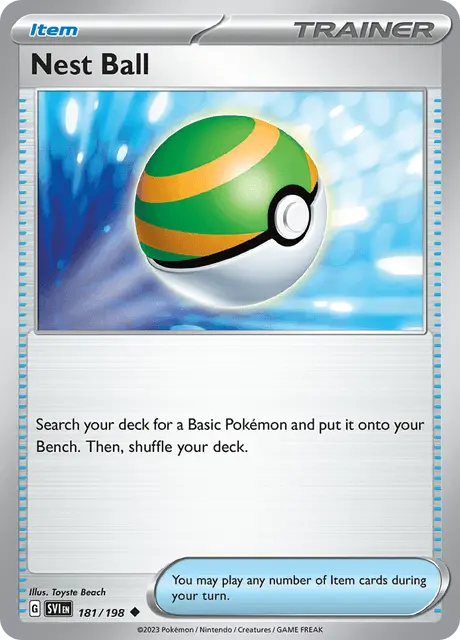
Starting with Item cards, some of the staples in the current format include Nest Ball and Ultra Ball, which help search out Basic and Evolution Pokémon. Decks that run low-HP Basics can also make use of Buddy-Buddy Poffin for added consistency. Counter Catcher is another popular choice, offering a strong comeback option by letting the player target a Benched Pokémon when behind on Prize cards. It can even be used to pull up a support EX like Mew EX for an easy 2-Prize knockout.
Given the variety of decks in the current meta, with each deck having a different ideal set-up, the remainder of the Item cards in the deck vary greatly. Some require Rare Candy, Tera Orb, or Energy Search.
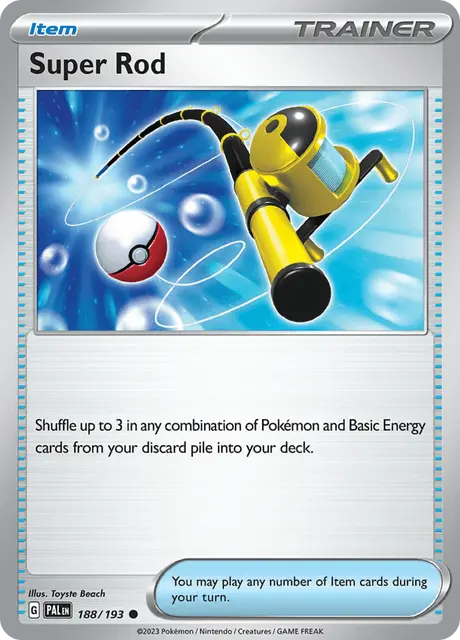
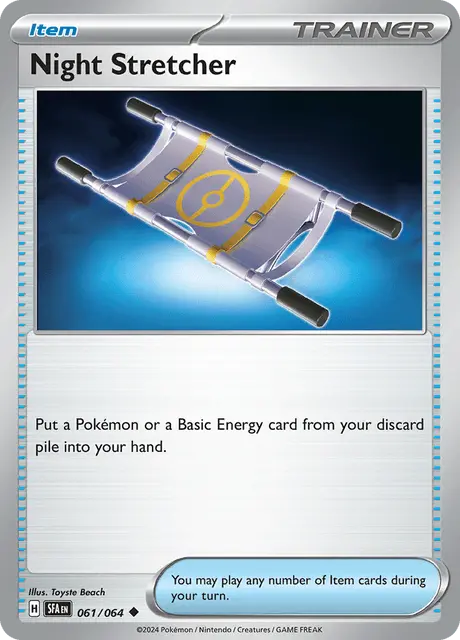
For Pokémon and Energy recovery, Super Rod and Night Stretcher are the go-to cards. One important thing to note about recovery cards is not to include too many copies, especially Super Rod. Most decks run just one copy of Super Rod, and at most two Night Stretchers. Drawing these cards in your opening hand can lead to a brick, potentially ruining your game from the start.
Supporter
Supporter cards are typically stronger than Item cards, which is why you can only play one per turn. Choosing the right Supporter each turn can help you build your board more effectively and lead you to victory.
Commonly used Supporters in current decks include Professor’s Research, Iono, Arven, and Boss’s Orders. Others are more deck-specific, such as Crispin, Professor Turo’s Scenario, and more.
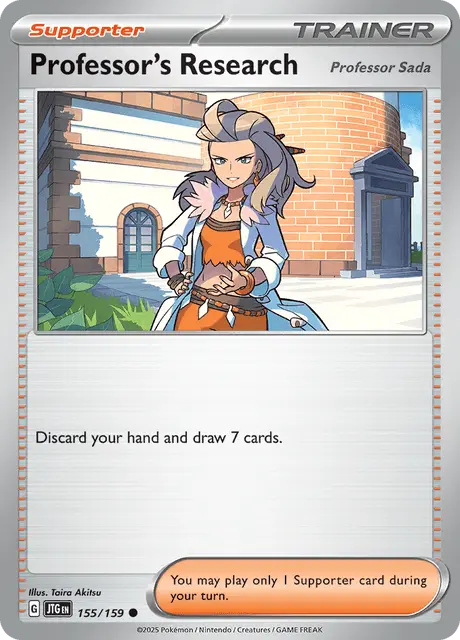
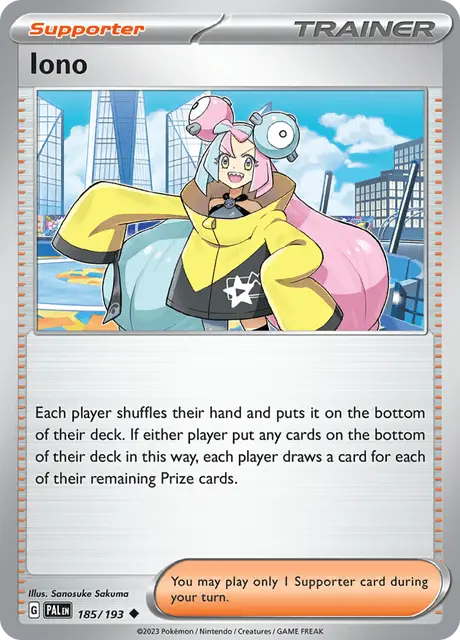
Let’s go through the commonly used Supporters. Both Iono and Professor’s Research serve similar purposes—they help refresh your hand. However, Iono depends on how many prize cards you and your opponent have, and it also gives your opponent a chance to refresh their hand. Sometimes, drawing Iono later in the game can be risky if you don’t have a way to draw more cards, such as through Mew EX or Drakloak, which could result in locking yourself out of options.
On the other hand, Professor’s Research has the downside of forcing you to discard your entire hand. You often have to decide whether it’s worth discarding everything for a fresh 7 cards. More often than not, you should still go for it, especially since most decks run multiple copies of key Item and Supporter cards, and Pokémon can often be recovered with recovery cards.
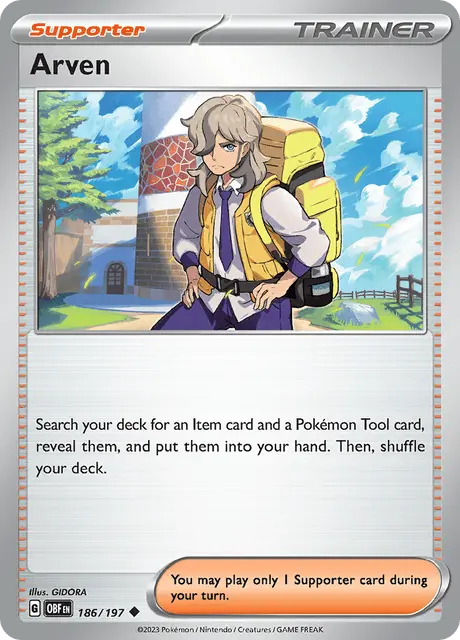
Arven helps you search out both an Item card and a Pokémon Tool. Need a Rare Candy to evolve Impidimp into Marnie’s Grimmsnarl EX? Use Arven to grab it. Want a Counter Catcher to knock out a benched Fezandipiti EX? Arven can get it. Looking for a Nest Ball to find a support Pokémon like Mew EX? Arven has you covered.
By including a wide variety of Item cards in your deck, Arven can help bail you out of sticky situations. Not to mention that it helps you find useful Tools such as Rescue Board.
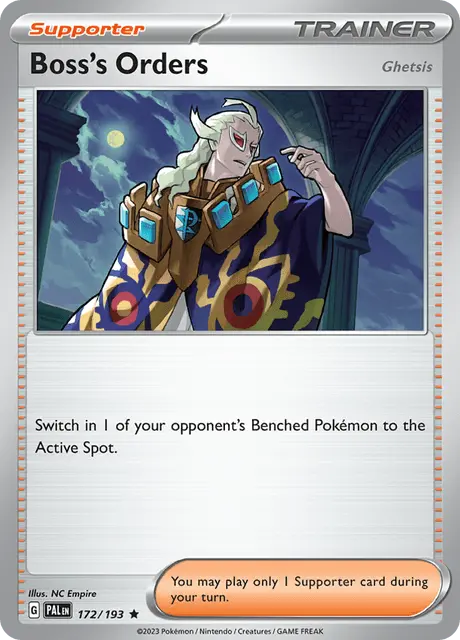
Boss’s Orders needs little explanation. It’s your Supporter Gust effect, allowing you to extend your Prize lead, KO Pokémon that are still setting up, such as Kirlia or Drakloak, to prevent them from evolving into their Stage 2 forms, or pull a high-retreat-cost Pokémon from the Bench to trap it in the Active Spot. However, using it means you’ve spent your Supporter for the turn, so timing is crucial.
You typically shouldn’t run more than 2 copies, as it holds little value when drawn early in the game.
Stadium
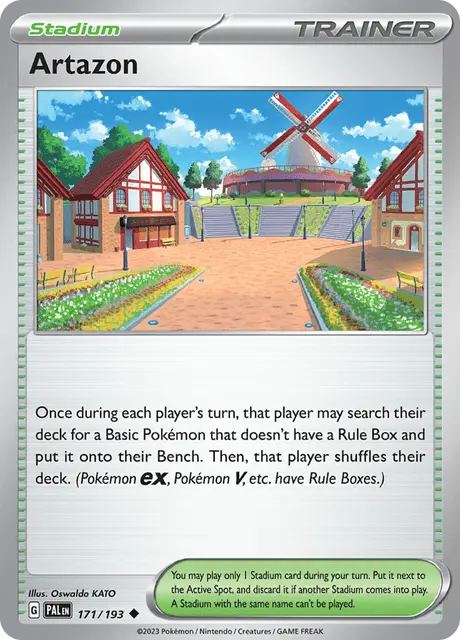
Stadium cards are normally very deck-specific. Not all decks require a Stadium, although it can be very useful to have one if it fits your strategy. The most commonly used Stadium is likely Artazon, which allows players to search out 1 Basic Pokémon without a Rule Box and place it on their Bench.
With Stadium cards being deck-specific, games can often lead to Stadium wars, as players try to discard each other’s Stadiums to limit their advantage. Examples include Area Zero Underdepths, which allows Tera decks to have up to 8 Benched Pokémon. Discarding the Stadium forces the Tera deck user to discard up to 3 Pokémon. So, sometimes, including a Stadium as a tech option can be worth considering.
Tool
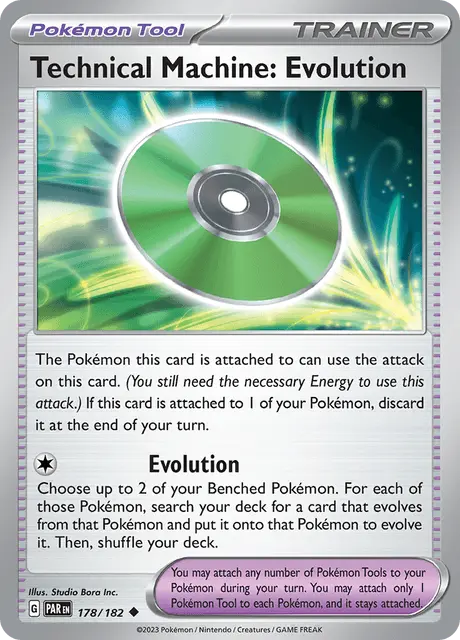
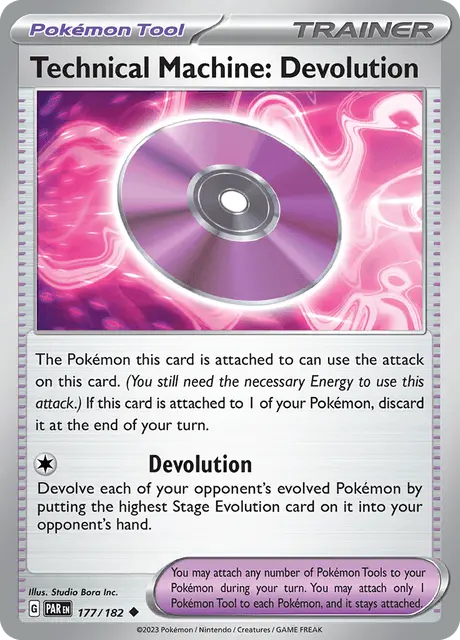
Just like Stadium cards, Tool cards are very deck-specific, such as Bravery Charm and the two Technical Machine cards. While Bravery Charm might seem universal, not all decks feel the need for the extra 50 HP, especially since it only works on Basic Pokémon. Another commonly used card is Rescue Board, which reduces the holder’s retreat cost by 1. This is often paired with Tatsugiri, so you can promote it to the Active spot after each knockout and use its Ability.
Pokémon Tools can be a strong set of cards to include in decks, with Jamming Tower being the only primary disruptive card against Pokémon Tools.
ACE SPEC
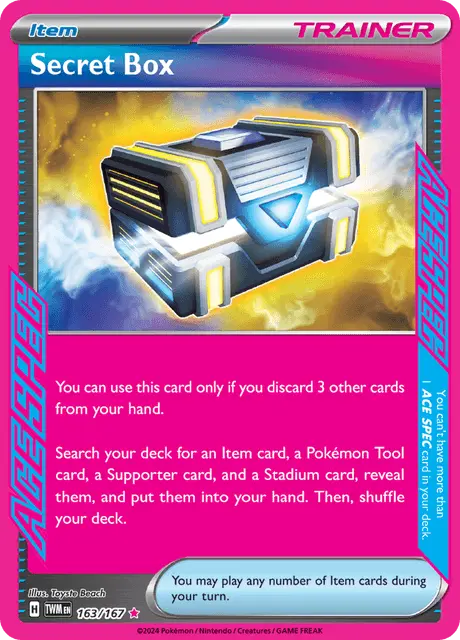
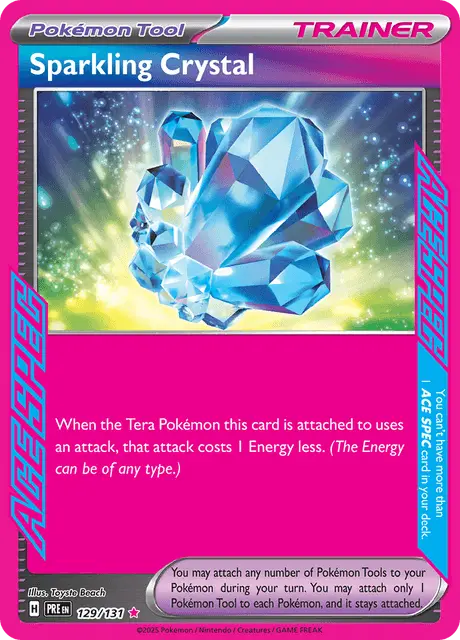
ACE SPEC cards are a returning feature from the Black and White era, where they are powerful Trainer cards limited to one copy per deck. ACE SPEC cards can be Items, Energy, or Tools. This adds an interesting layer to deckbuilding and makes each player’s choices feel unique.
Given how strong the effects are when used correctly, an ACE SPEC can effectively win you the game if played at the right time. The ACE SPEC Secret Box allows you to search for four Trainer cards, one each of an Item, Supporter, Tool, and Stadium, at the cost of discarding three cards. No other card offers an effect quite like this. Another strong ACE SPEC is Prime Catcher, which gives you a Gust effect while also letting you switch your Active Pokémon with one on your Bench. This is a huge advantage compared to using a Supporter like Boss’s Orders.
Each ACE SPEC has its own unique effect, and players should choose the one that best fits both their deck and their playstyle.
Energy Cards
As long as your deck runs efficiently with various search support like Energy Search, Crispin, or Earthen Vessel, you don’t need to include 15 to 20 Energy cards out of fear of not drawing into them. With the right draw and search support, you should be able to find your Energy cards quite easily—or at least your Basic Energies.
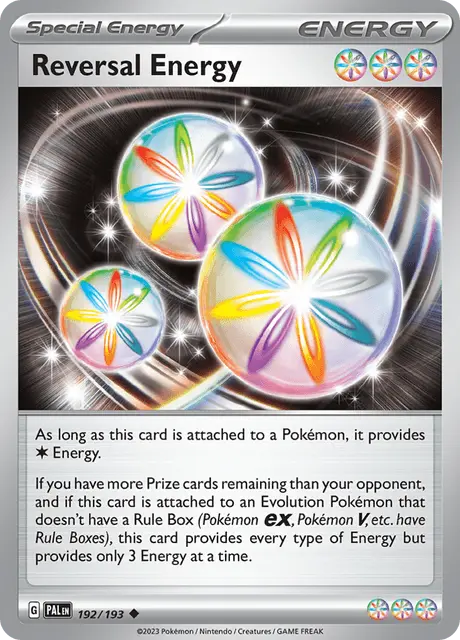
Because another sub-tier of Energy cards is your Special Energy cards—think Luminous Energy, Jet Energy, Reversal Energy, and Legacy Energy. These are all Energy cards with special effects that can turn the tide of a game if you draw into them.
However, the downside of these Special Energy cards is that they’re not as easy to search out. Cards like Energy Search and Crispin specifically state that they only search for Basic Energy, not Energy in general. This is an important consideration when deckbuilding.
So, how do you get these cards quickly if you can’t search for them directly? You’ll need a strong Trainer and Supporter core to help thin your deck—cards like Professor’s Research and Iono. By running multiple copies of the Special Energy you need (commonly 3 to 4 copies of something like Luminous Energy) and thinning your deck early, your odds of drawing into one are much higher.
So, how many Energy cards should be enough? You’re usually looking at around 8 to 12 total Energy in your deck, including Special Energy. But why so few? Because most competitive attackers only require 1 or 2 Energy to attack, rarely 3. Plus, most decks include some form of Energy acceleration, recovery, or recycling.
Even if you’re playing a deck with a high Energy discard rate, such as a Raging Bolt EX deck, it will have built-in methods to recover Energy through cards like Professor Sada’s Vitality, Superior Energy Retrieval, and Night Stretcher.
Closing Thoughts
Ultimately, deckbuilding should still be a personalized process. It takes multiple iterations to get a deck that feels right to the player. Sometimes it could mean putting 1 extra copy of a card as compared to others, but if that works for you, why stop yourself? Keep chopping and changing cards until you find your perfect 60-card list!


